flasmon
/ˈflaz.mɒn/ · noun · plural flasmons
flame × plasmon; coined 2026. Siblings: flasmonics, the engineering of flasmon-emitting media, and chemiphotovoltaics, the conversion architecture that harvests them.
The quantum of chemically-pumped, optically-resonant emission in a reacting medium — a photon whose upper state was filled by reaction affinity, not temperature, escaping through a medium thick on its own line.

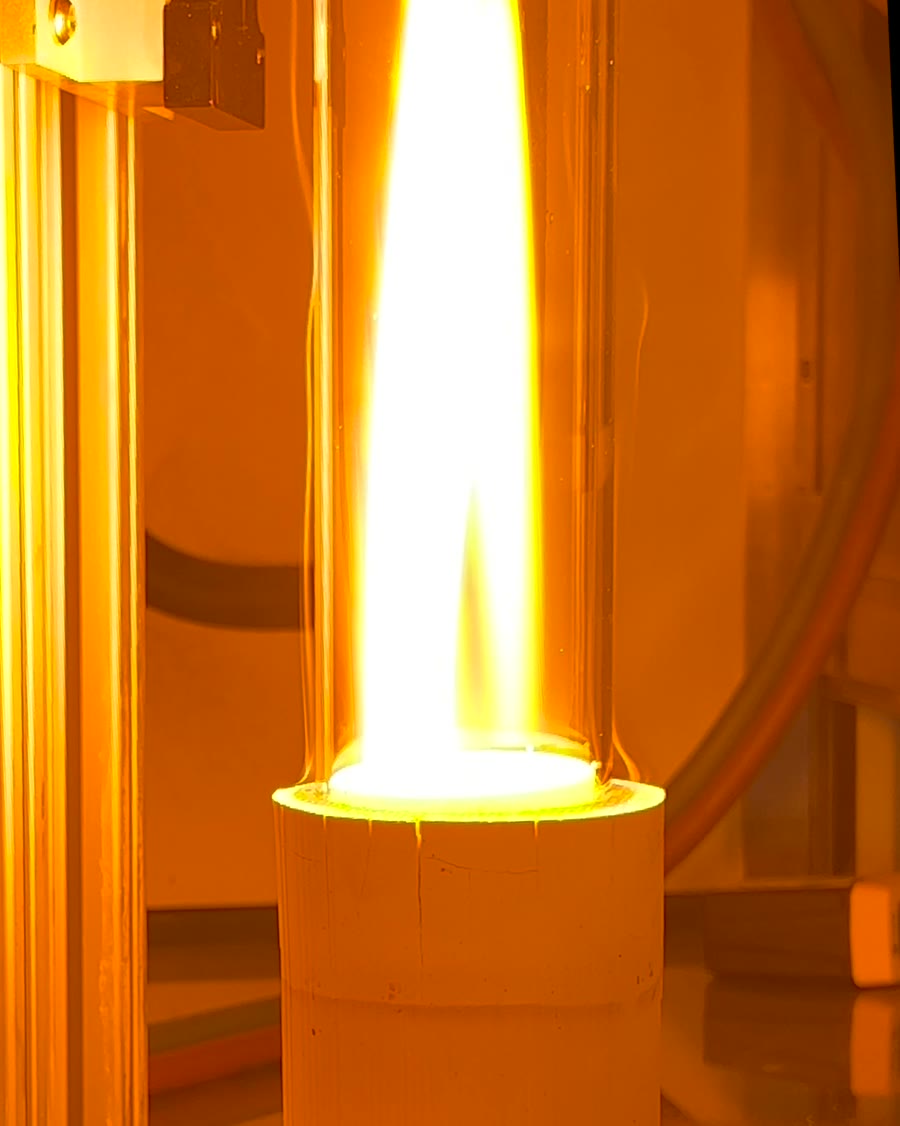
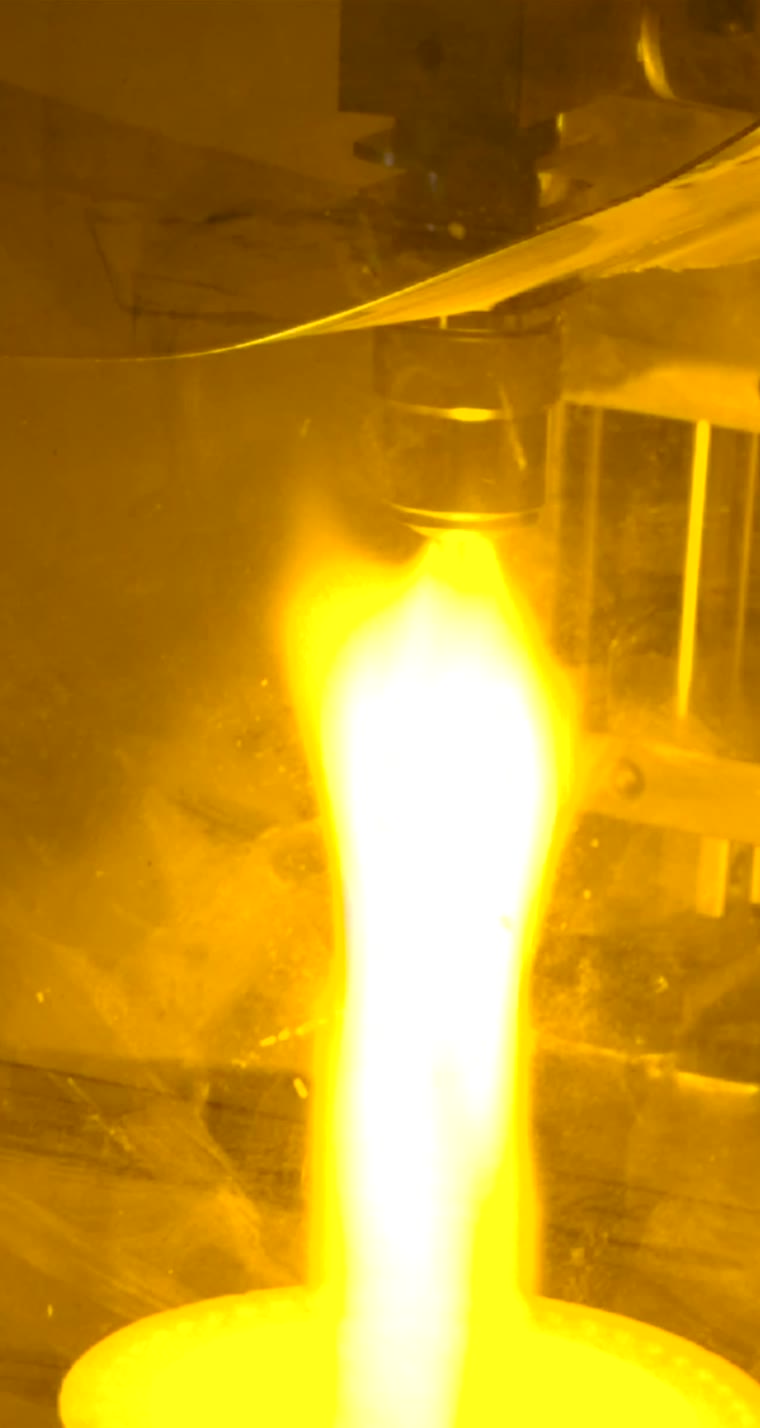
the column itself — sodium flame confined in quartz,
LightCell bench, 2026. real footage, not a render.
01 · The identity
μ = hν ( 1 − Tgas / Tb )
Gas at Tgas = 2400 K whose D line reads
brightness temperature Tb = 3000 K
emits photons carrying μ = 0.42 eV —
20% of each photon is work, not heat.
drag the dashed numbers · gray: thermal continuum at Tgas · yellow: the D line reaching its brightness temperature · dashed: blackbody envelope at Tb · stylized scales
the two-line derivation (exact, no Wien approximation)
μ = hν (1 − Tgas/Tb) // exact
Würfel's generalized Planck law lets emitted light carry a chemical potential μ: occupation ∝ 1/(exp((hν−μ)/kT)−1). established Where the line is optically thick, emergent radiance approaches the source function and the identity above is exact algebra. established Its reading is thermodynamic: the work fraction of the photon equals the Carnot factor between brightness and gas temperature. established Measuring Tb > Tgas on a line is measuring μ > 0; if the line is thin, the inferred μ is a lower bound. established Treating the whole line with a single μ assumes quasi-equilibrium within the emitting manifold — a modeling choice. conjectured
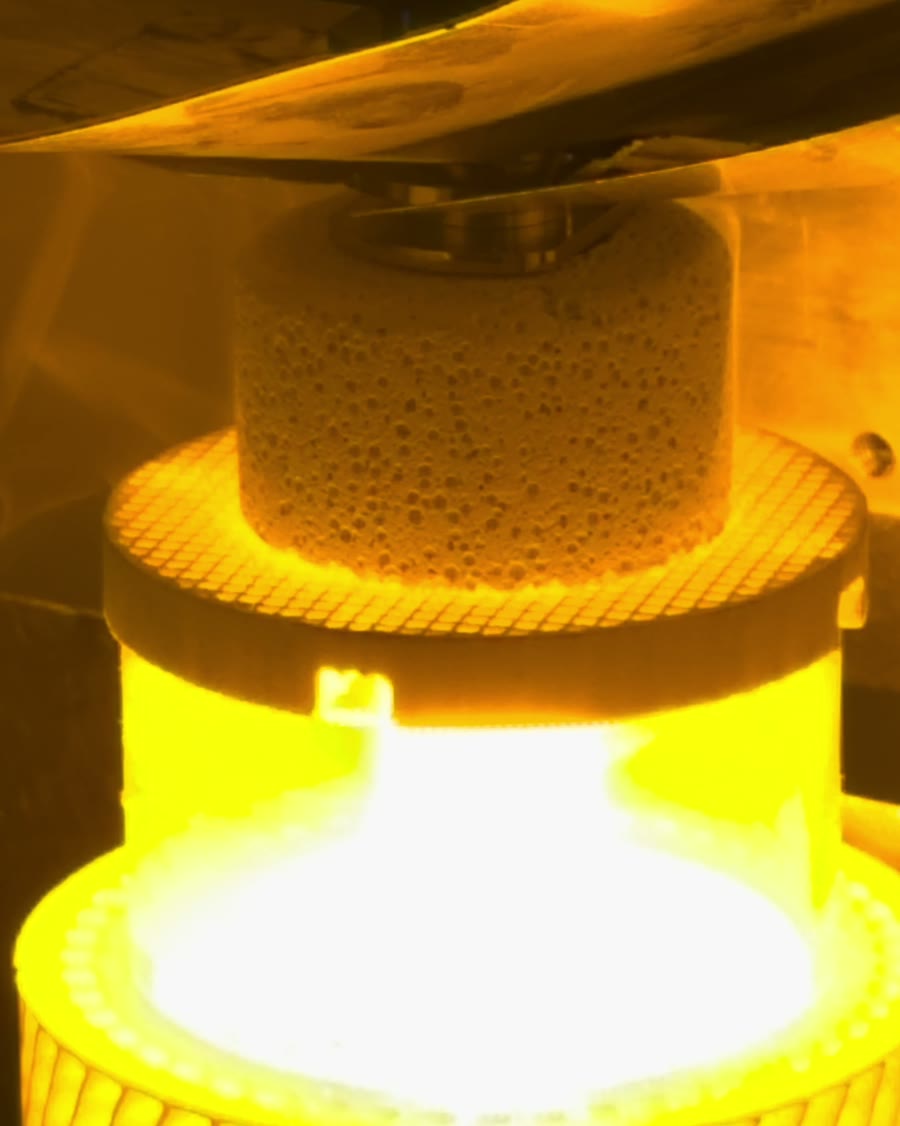
the photograph, the prediction, the measurement
same physics, three ways — the bench, the renderer, and the spectrometer saying the same sentence.


02 · Three kinds of photon
An LED's light carries μ = qV, drawn from the battery across its junction; a flasmon's μ is drawn from the affinity of the reaction that excited it. Same thermodynamic object — luminescence, light with free energy, no inversion required established — different reservoir. Whether the analogy holds quantitatively at flame conditions is the working question. conjectured Chemical pumping can go all the way: HF/HCl chemical lasers pass μ = hν into inversion on chemistry alone. established The flasmon claims the easier regime below threshold — no cavity, no inversion, still work-bearing light. conjectured
03 · Where the free energy comes from
Flame fronts overshoot: fast bimolecular shuffles (H₂ + OH ⇌ H₂O + H) hold radical ratios in partial equilibrium while slow three-body recombination drains the pool — so H and OH run far above equilibrium and decay slowly. established That pool is a charged capacitor. Seed it with sodium and it discharges radiatively: H + H + Na → H₂ + Na* — the Padley–Sugden mechanism, measured above thermal in hydrogen flames in the 1950s. established The ledger isn't thermally throttled: ~4.5 eV per recombination event against 2.1 eV per D-line photon. established
Because the shuffle pins ratios while the sink drains slowly, the affinity released per event — and so the μ it can imprint — holds roughly constant across the emission zone: a buffer for photon chemical potential, as a pH buffer pins the proton's. conjectured The bound (photon μ ≤ pump affinity) is a detailed-balance argument we treat as plausible, not proven. conjectured
04 · See the non-thermal component
Same video frame, twice. Drag the line: left of it, the frame as shot; right of it, the flame's emission layer separated from ambient daylight. The isolated layer is the part of the image the chemistry made.

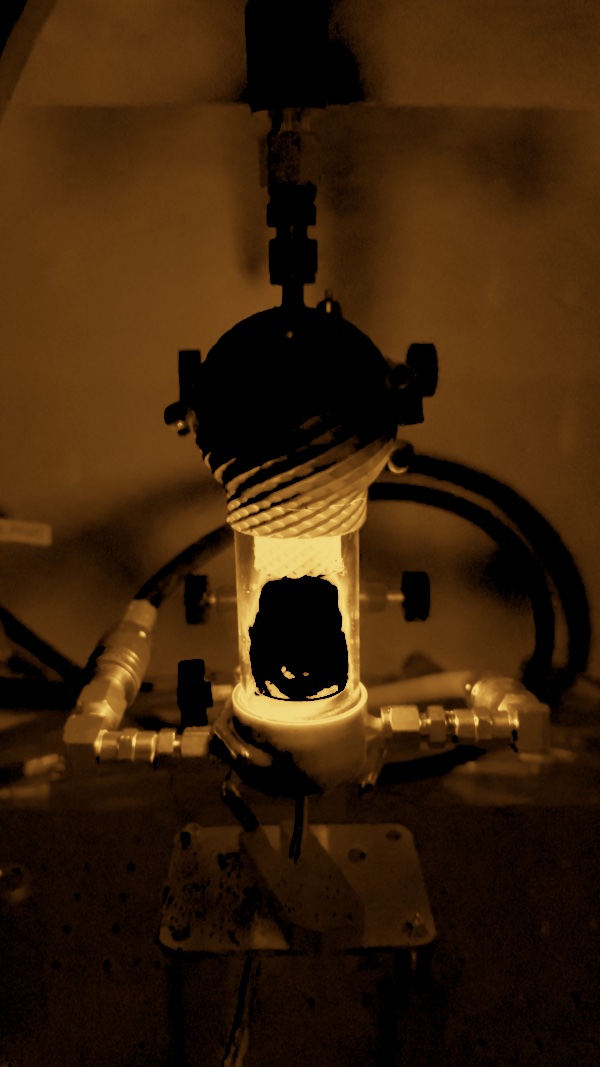
source separation of LightCell bench footage — the daylight layer and flame layer unmixed per-pixel.
05 · The same light, other bodies
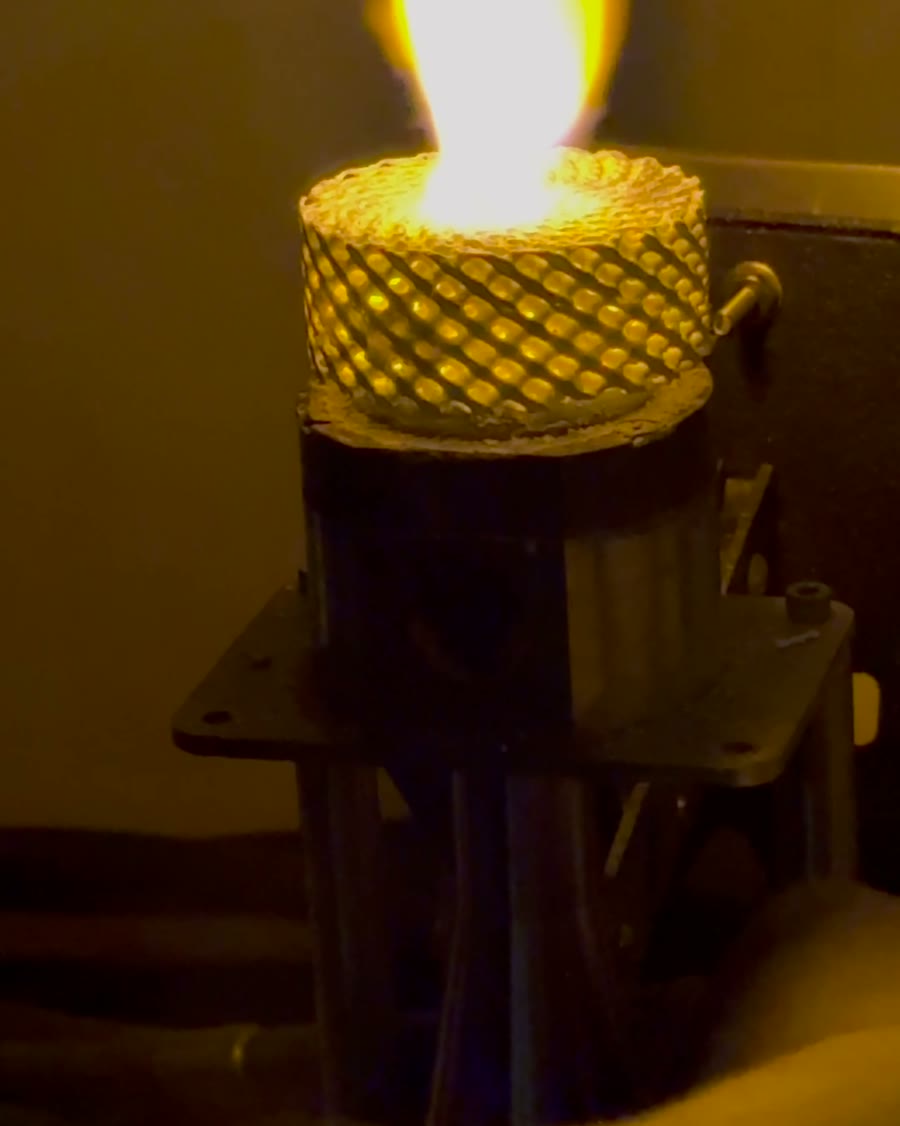
One emission process, many vessels — recent frames from the bench, all SDR grades of real footage.
06 · Run the physics
These are not figures. Each panel below is a live model running in your browser, drawn from the same research library. Drag the sliders; the physics recomputes as you move.
the trap · resonant imprisonment, live
open full ↗the line · emergent doublet, self-reversed core
open full ↗the run · row 18, measured
open full ↗deeper in the library
07 · The operating point
A flasmon dies by collision, not by scattering — quenching thermalizes the pump; re-scattering just delays escape. established So the medium has an interior optimum. Too hot: the equilibrium pool catches the superequilibrium pool, affinity → 0, and the Carnot factor is squeezed. Too cold: kinetics die while collisions persist. The dissociation-buffer operating point is the (T, p, seed) region where escape beats quench while the buffer stays charged. Existence of a useful optimum: conjectured. Sustained μ > 0: signal observed — row 18, 2023-08-07: μγ > 0 held ~150 s across 37 co-temporal acquisitions at torch-driven optical depth, super-Planckian across the credible width–Tkin grid; killed by a smoke alarm before steady state. The emitter is pinned ≥ 2400 K by the catalytic cycle itself (sourced rates; per-cycle yield 0.96 at the pinch) — the chemistry lands on the swirl point. At full device power draw: unmeasured.

the medium at work — flame structure visible inside the quartz column.
08 · row 18 — measured
2023-08-07 · NaI, 48 mm × 6 in quartz · 207 co-temporal luminance + spectrum acquisitions over 545 s. The logbook's all-time luminance record — and the first run with the driven potential μγ(t) tracked across the whole arc. signal observed · full notebook + lab ↗
the canonical row-18 page, embedded — same source, one truth. open full ↗
09 · Lineage
- P. Würfel, “The chemical potential of radiation,” J. Phys. C 15, 3967 (1982) — light as a carrier of free energy.
- F. Herrmann & P. Würfel, “Light with nonzero chemical potential,” Am. J. Phys. 73, 717 (2005) — the pedagogical treatment.
- P. J. Padley & T. M. Sugden, “Chemiluminescence and radical recombination in hydrogen flames,” 7th Symp. (Int.) on Combustion (1958); T. M. Sugden, Annu. Rev. Phys. Chem. 13, 369 (1962).
- A. G. Gaydon & H. G. Wolfhard, Flames: Their Structure, Radiation and Temperature — line-reversal photometry; reaction-zone excitation temperatures.
- J. V. V. Kasper & G. C. Pimentel, “HCl chemical laser,” Phys. Rev. Lett. 14, 352 (1965); R. W. F. Gross & J. F. Bott, Handbook of Chemical Lasers (1976).
- T. Holstein, “Imprisonment of resonance radiation in gases,” Phys. Rev. 72, 1212 (1947).